The Insulation-First Approach That Saves Greely Homeowners Thousands
Greely is a growing community south of Ottawa, where many homes sit on larger rural lots and experience slightly colder temperatures than urban Ottawa due to open-field wind exposure. At Dtech Services, we've learned something important from our Greely projects: upgrading your heating system without first addressing insulation is like buying a faster car without fixing the flat tires.
When a Greely homeowner calls us about replacing their furnace or installing a heat pump, our first question is always about their attic insulation. In roughly 60% of Greely homes we assess, the attic insulation is below current code requirements—and that directly affects what size heating system you need and how much you'll spend to operate it.
What We Find in Greely Attics
Greely homes built before 2000 typically have 6-8 inches of fibreglass batt insulation in the attic, providing an R-value of approximately R-20 to R-25. Current Ontario Building Code requires R-60 for new construction, and energy efficiency programs recommend at least R-50 for retrofits. That gap between R-25 and R-50 represents a massive amount of heat escaping through your ceiling every winter.
Our thermal imaging assessments of Greely attics consistently reveal:
- Significant heat loss around pot light fixtures (each uninsulated pot light is equivalent to leaving a 4-inch hole in your ceiling)
- Gaps at the attic hatch—most Greely homes have pull-down attic stairs or simple hatches with minimal or no insulation
- Compressed insulation near eaves where the roof slope meets the attic floor, reducing effective R-value by 50% or more
- Missing vapour barrier or vapour barrier punctured by previous electrical or plumbing work
How Insulation Affects Heating System Sizing
Here's where the numbers tell the story. For a 2,000 sq ft Greely home, our Manual J load calculations show:
- With R-25 attic insulation: Heating load of 52,000 BTU, requiring a 4-ton heat pump or 60,000 BTU furnace
- With R-50 attic insulation: Heating load of 38,000 BTU, requiring a 3-ton heat pump or 45,000 BTU furnace
That's a 27% reduction in heating load just from attic insulation. The practical impact: a smaller, less expensive heating system that runs more efficiently. The difference in equipment cost between a 3-ton and 4-ton heat pump is approximately $2,500-$3,500. When you add the reduced operating costs over 15-20 years, insulating first saves $8,000-$12,000 over the system's lifetime.
Greely Attic Insulation Project: Bank Street South
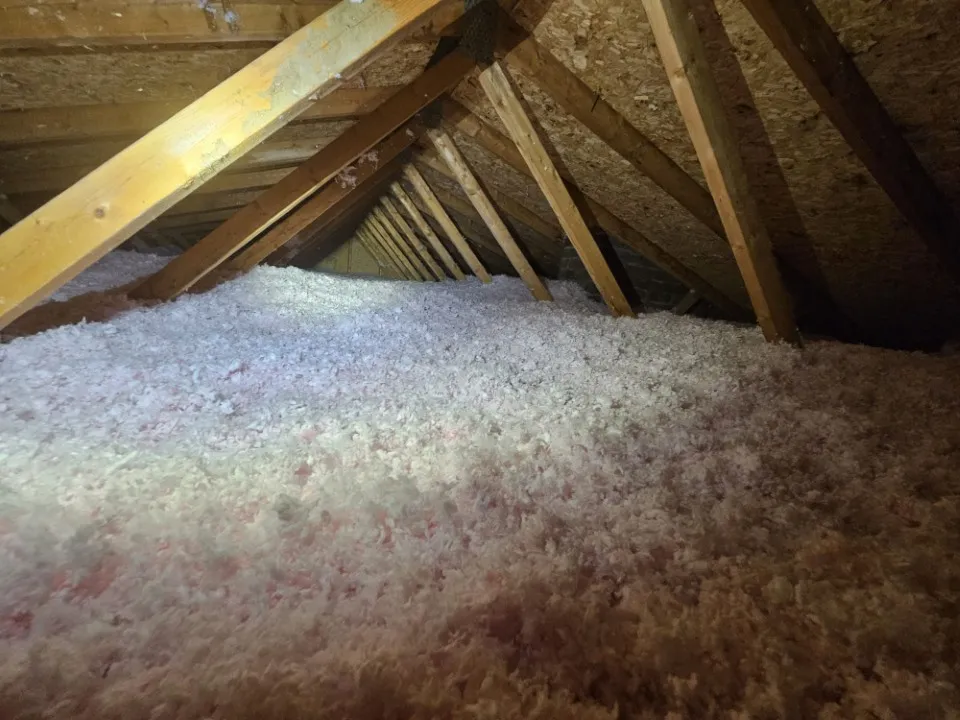
In January 2026, we completed an attic insulation upgrade for a Greely home on a rural property off Bank Street South. The 1,800 sq ft bungalow had original R-20 fibreglass batts from 1992, with visible gaps and compressed areas throughout.
Our scope of work included:
- Air sealing all penetrations (17 pot lights, plumbing stack, electrical wires, attic hatch) using fire-rated caulk and rigid foam
- Installing baffles at every rafter bay along the eaves to maintain soffit ventilation
- Blowing R-50 cellulose insulation over the existing fibreglass (cellulose settles into gaps better than fibreglass and provides superior air-sealing properties)
- Insulating and weatherstripping the attic hatch to R-30
Total cost: $4,200 installed. The homeowner then proceeded with a heat pump installation the following month—and because we'd reduced the heating load, we were able to install a smaller, more affordable 2.5-ton unit instead of the 3.5-ton system that would have been required without the insulation upgrade.
The Right Order of Operations for Greely Home Energy Upgrades
Based on our experience with Greely properties, we recommend this sequence for maximum value:
- Step 1: Get an EnerGuide evaluation (required for most rebate programs and provides your baseline)
- Step 2: Address air sealing and attic insulation first
- Step 3: Upgrade your heating system, now properly sized for the improved building envelope
- Step 4: Get the post-retrofit EnerGuide evaluation to unlock maximum rebates
This approach qualifies for the most rebate dollars because energy audit programs reward comprehensive upgrades. A Greely homeowner doing both insulation and a heat pump can stack rebates totalling $10,000-$15,000 depending on the specifics.
Dtech Services offers both insulation and heating system services, which means one contractor manages your entire energy upgrade—no coordination headaches between separate companies. Book a free assessment for your Greely home and we'll map out the most cost-effective upgrade path.